
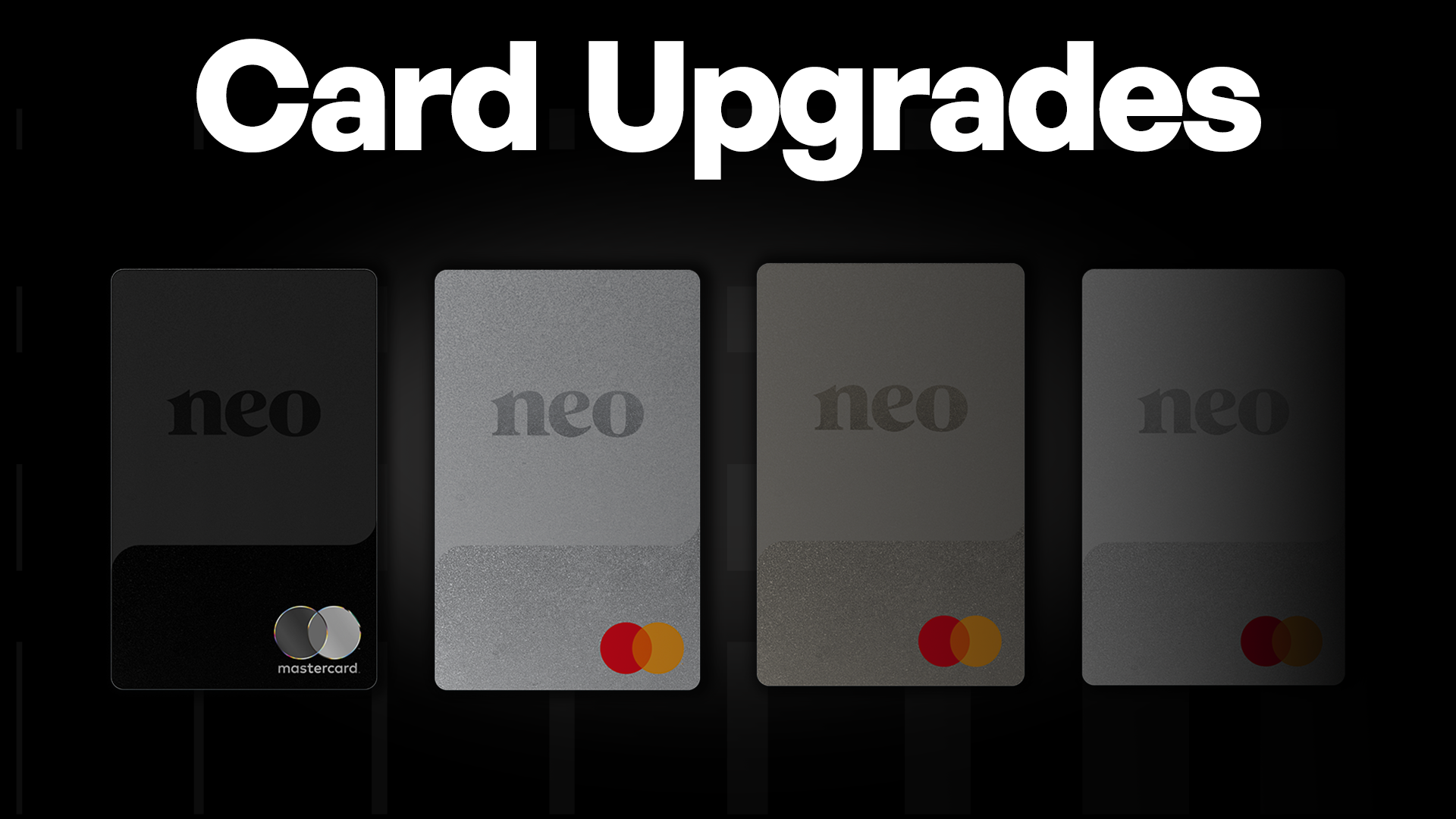
Turning a narrow upgrade flow into a flexible card-change system
Company: Neo Financial
Year: 2026
Role: Product Design Lead
About
Neo’s original card upgrade experience was built to solve one specific problem: allowing eligible customers to move from their existing credit card to a higher-tier product.
As Neo’s credit card portfolio evolved, that model became too limited. Customers wanted more control over their cards and rewards, the business needed more ways to deepen customer relationships, and a major portfolio migration introduced a hard deadline for expanding the system.
Over three months, we evolved Card Changes into a flexible system that could support different types of product changes, customer-initiated requests, targeted offers, and the migration of Tim Hortons credit card customers into Neo.


The problem
Neo launched the first version of its card upgrade system in late 2024.
The experience was intentionally narrow. Eligible customers could receive an offer to move from their current card to a higher-tier product, such as Neo World to Neo World Elite. It was a deliberate MVP that allowed Neo to validate the underlying infrastructure before expanding it.
But it only supported one movement:
Current card → Higher-tier card
Customers could not initiate a change themselves, switch rewards propositions, or choose between different eligible card configurations.
Why the MVP had to evolve
Three needs quickly pushed the system beyond its original scope.
More customer choice
Customers wanted cards and rewards that better reflected how they spent, rather than relying only on slow progression to higher card tiers.
Customers wanted cards and rewards that better reflected how they spent, rather than relying only on slow progression to higher card tiers.
More ways to deliver value
Changing rewards created another way for Neo to improve the customer proposition without requiring a full card upgrade.
Changing rewards created another way for Neo to improve the customer proposition without requiring a full card upgrade.
A portfolio-scale migration
Tim Hortons was discontinuing its credit card program, creating the need to transition eligible cardholders from another brand and ecosystem into Neo.
Tim Hortons was discontinuing its credit card program, creating the need to transition eligible cardholders from another brand and ecosystem into Neo.
What had started as a simple upgrade flow now needed to support significantly more customer and business scenarios.
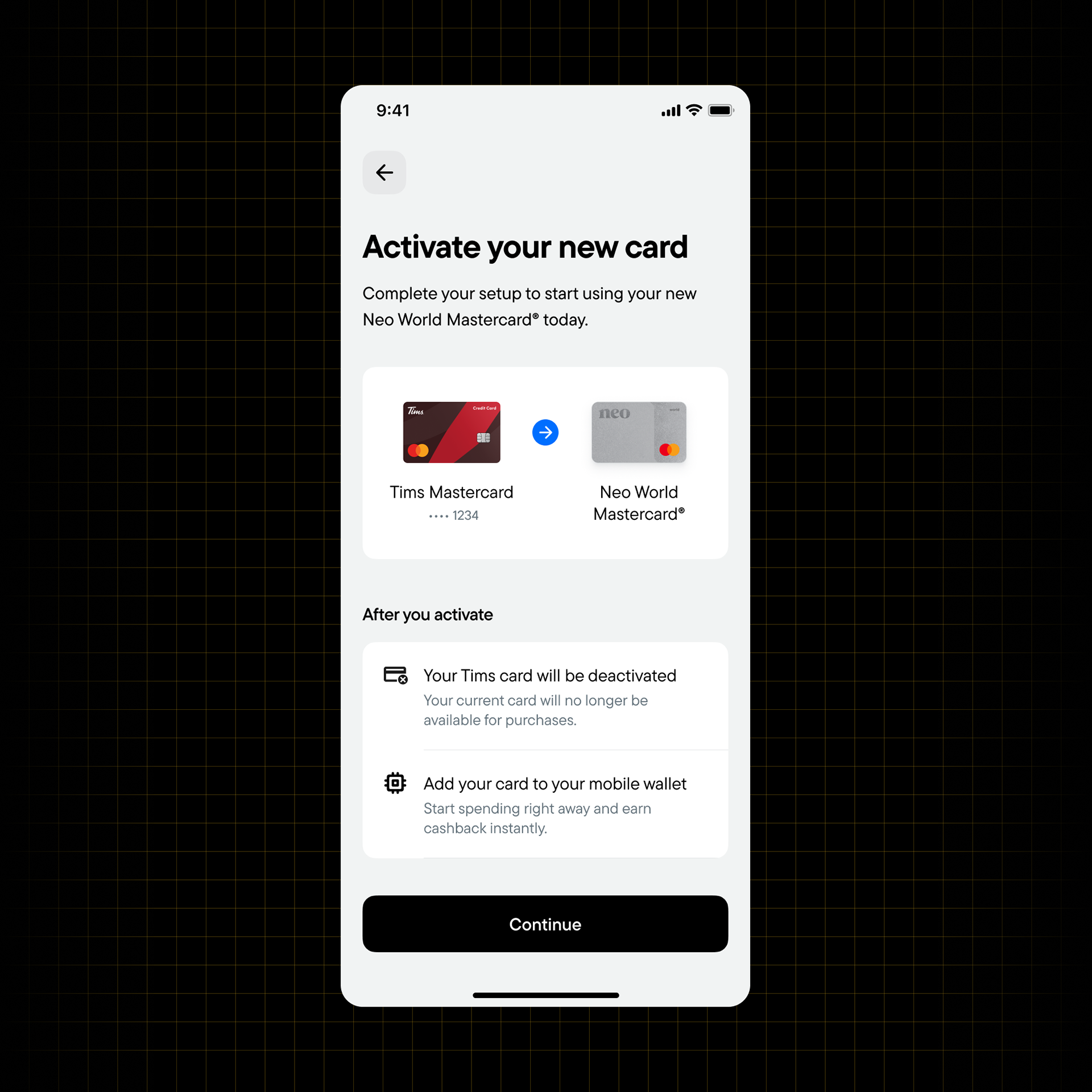

We had three months to evolve a constrained upgrade experience into a system that could support multiple card configurations, different customer intents, and the migration of an external credit card portfolio.
The design challenge became:
How might we give customers significantly more flexibility without exposing the complexity of Neo’s underlying credit and card infrastructure?
Mapping the system
A credit card at Neo was not a single product definition and each card was composed of several dimensions.
Customers could not simply browse the entire portfolio and select any product. The options available to them depended on their credit eligibility, current card, destination product and the type of change being requested.t
The design problem was therefore not just about presenting more card options. It was about translating a rules-heavy financial system into choices customers could understand and trust.


Once we mapped the system, most card changes could be described through three basic movements.
Vertical: Moving to a higher card tier.
Horizontal: Keeping the same tier while switching rewards.
Diagonal: Changing both card tier and rewards at the same time.
This became an important model for both the product team and the experience.
Instead of treating every card combination as an independent flow, we could design around the nature of the change taking place.
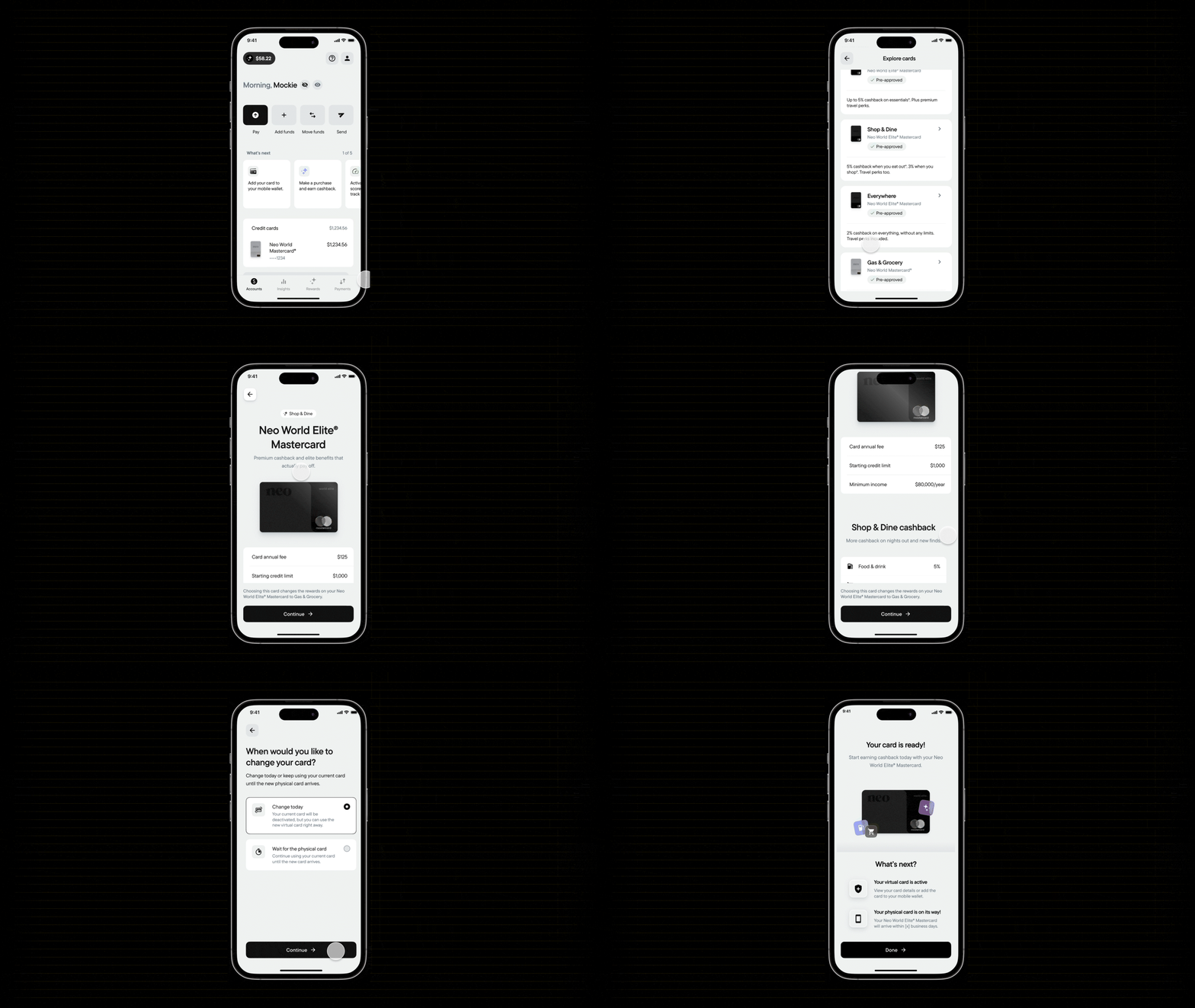
Designing the card-change ecosystem
This became the core of the project.
Card Changes could not exist as an isolated upgrade flow. A single change could affect eligibility, card selection, physical cards, virtual cards, rewards, shipping, activation, product details and other surfaces across Neo.
That required us to design the ecosystem around a shared set of rules and reusable interaction patterns rather than individual card combinations.
That required us to design the ecosystem around a shared set of rules and reusable interaction patterns rather than individual card combinations.
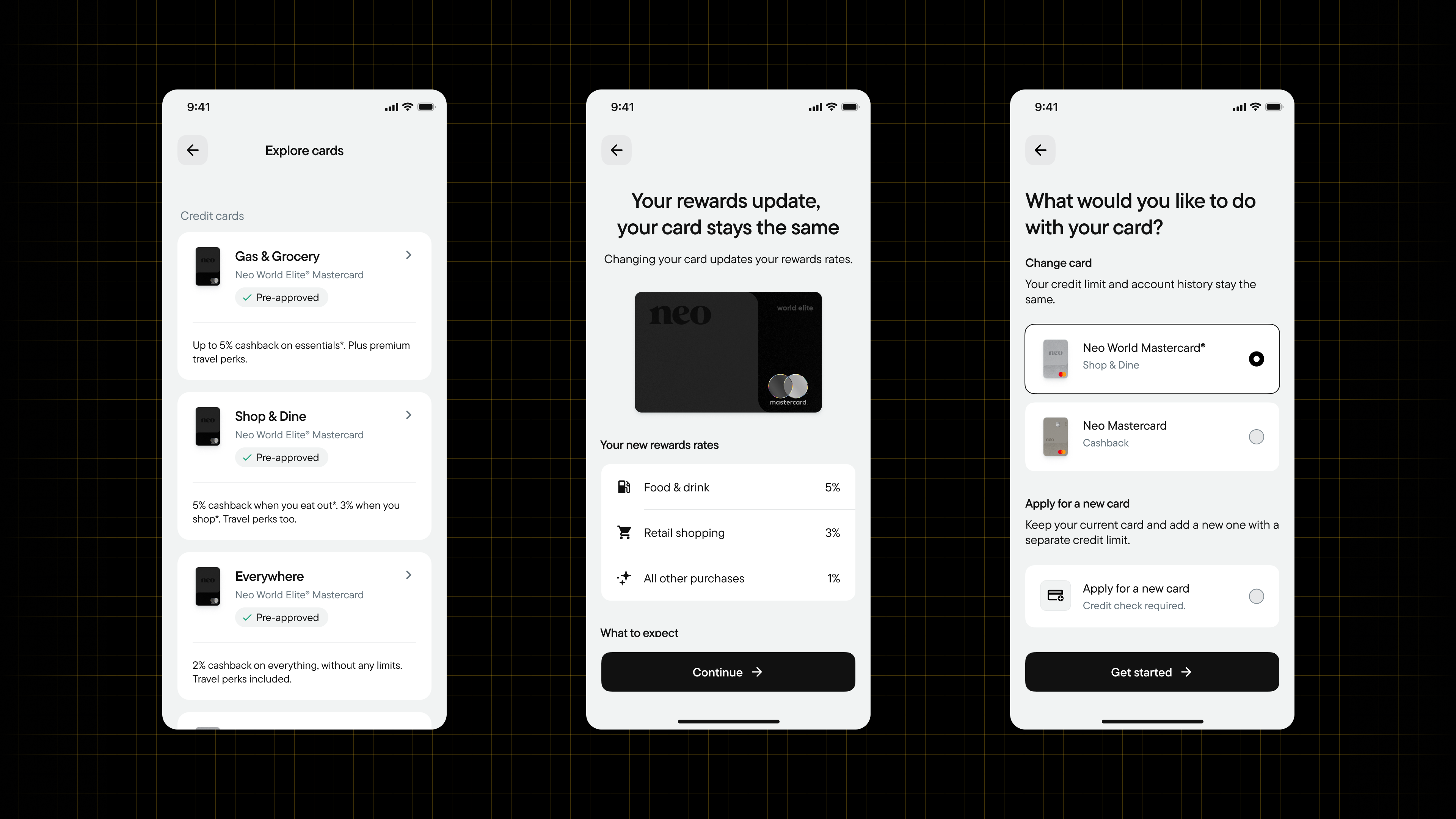
Turning system complexity into customer decisions
1. Guiding customers to the right action
The eligibility engine filtered that complexity before customers had to deal with it, allowing us to show only products they were already eligible to move to.
From there, customers sometimes had another important choice:
Change my current card
Replace the product they already had.
Replace the product they already had.
or
Apply for another card
Keep their existing product and add another one.
Keep their existing product and add another one.
These actions could lead to the same destination card but had very different consequences.

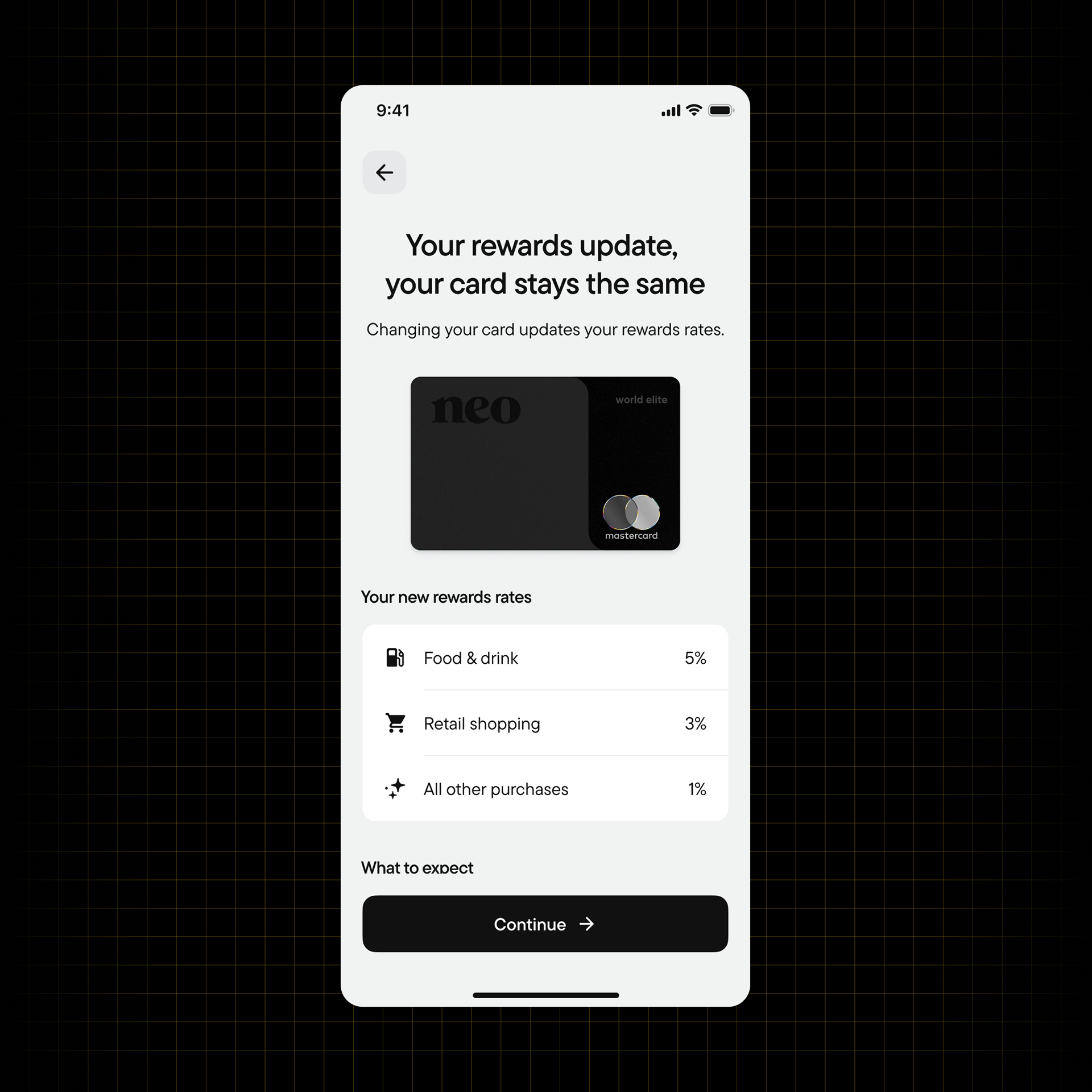
2. Making every change predictable
Different card changes could affect different parts of the customer’s account.
A customer might receive:
• a new physical card;
• new card credentials;
• a different rewards proposition;
• a changed virtual card;
• new card credentials;
• a different rewards proposition;
• a changed virtual card;
or a temporary period where old and new card states existed simultaneously.
Instead of describing the system itself, the experience focused on consequences.
3. Designing for the full lifecycle
Depending on the scenario, the experience could continue for several days while a physical card was produced, shipped, received and activated.
During that period, Card Changes had to stay synchronized with adjacent systems across Neo.
The work therefore moved beyond designing a transaction flow and into defining how a card change should behave across its entire lifecycle.
By building around shared states and reusable patterns, the system could support new card combinations without requiring a completely new experience each time.


Tim Hortons became the first major test of the system
The Tim Hortons card deprecation introduced a much larger version of the same problem.
Instead of moving an existing Neo customer between products, we needed to support customers moving:
• from another brand → into Neo
• from another app → into the Neo ecosystem
• from an ending card program → into an active Neo product
• from another app → into the Neo ecosystem
• from an ending card program → into an active Neo product
The migration required close collaboration across Product, Engineering, Operations and Marketing.
Card Changes provided the underlying product logic needed to match eligible customers with an appropriate Neo product and move them through the transition without creating an entirely separate migration system.
What started as an upgrade engine had become infrastructure capable of supporting both individual customer choice and portfolio-scale product changes.

Results

Exact metrics are omitted for NDA reasons.
Card Changes:
The expanded system performed in line with business expectations, with customers moving to higher-tier products and switching to rewards propositions that better matched their spending habits.
Following launch, Neo also observed increased average card spend among customers using the new Card Changes experience alongside improved customer satisfaction.
Tim Hortons migration
The Tim Hortons migration exceeded the business conversion target.
With Product, Engineering, Operations and Marketing working together, the majority of eligible Tim Hortons cardholders successfully transitioned into Neo.
The migration became one of Neo’s largest customer conversion initiatives of 2026 and demonstrated that the Card Changes system could support use cases far beyond its original upgrade MVP.
